


Chronic stress is not just “feeling busy” or “having a lot on your plate.” Over time, especially for women juggling work, caregiving, and emotional labor, stress can push the nervous system beyond fight-or-flight into something quieter and more confusing: shutdown.
You might recognize it as numbness, fatigue, brain fog, going through the motions, or feeling “checked out” from your own life. Your labs may look “normal,” but inside you feel anything but. Ayurveda for chronic stress gives us a language and a path forward for this state: understanding how stress derails prana (life force), weakens agni (digestive fire), and depletes ojas (vital essence), and how we can gently rebuild from the inside out.
In this deep dive, we will explore what chronic stress shutdown and “freeze mode” look like, how modern science and Ayurveda describe its impact on your body, and which practical Ayurvedic tools—daily rhythm, food, herbs, yoga, and breath—can help you move from shutdown back toward safety, connection, and vitality.
What Is Chronic Stress Shutdown or Freeze Mode?
From a nervous system lens, most people know fight-or-flight. Freeze is the third pattern: instead of speeding up, the system collapses down. You might feel:
• Numb or emotionally flat
• Exhausted but wired
• Unable to make decisions or take action
• Dissociated or “not fully here”
• Oversleeping or scrolling just to “check out”
Polyvagal theory, developed by Stephen Porges, describes this as a protective response of the older dorsal vagal pathways: when neither fight nor flight seems possible, the body defends by slowing down, withdrawing, and conserving energy. In this state, digestion, immunity, and libido are often dialed down while you move through the day on autopilot. Porges’ 2022 paper in Frontiers in Integrative Neuroscience outlines how shutdown and immobilization are linked to this dorsal vagal defense and how cues of safety help the system re-engage.
From an Ayurvedic perspective, chronic stress shutdown looks like aggravated vata (disturbed prana, anxiety, depletion), disturbed pitta (burnout, irritability, inflammation), and eventually heavy kapha (lethargy, low mood, stuckness). Over time, this state erodes ojas, the subtle essence that governs immunity, resilience, and joy.
How Chronic Stress Rewires Your Biology
Ayurveda has always said: long-term stress disturbs the whole system. Modern research now shows us some of the mechanisms behind this.
A landmark study in the Proceedings of the National Academy of Sciences (PNAS) followed adults under long-term stress and found that chronic stress was associated with “glucocorticoid receptor resistance”—in simple terms, immune cells became less sensitive to cortisol, the hormone that normally turns off inflammation. This meant that even when cortisol levels were high, inflammation stayed elevated, increasing risk for illness.
A 2023 review in the International Journal of Molecular Sciences went further, summarizing how chronic stress disrupts the hypothalamic–pituitary–adrenal (HPA) axis, alters cortisol rhythms, and fosters a pro-inflammatory state that can contribute to autoimmune disease and other chronic conditions. The authors describe how long-term stress leads to impaired feedback in the stress axis and immune dysregulation.
Ayurveda would describe this cascade as:
• Agni becomes irregular or weak (vishama or manda agni).
• Ama (metabolic waste / toxins) accumulates in the gut and tissues.
• Doshas move out of their proper seats, especially vata.
• Ojas is slowly depleted, reducing your ability to bounce back.
The result? You may not have an obvious “illness label,” but you feel persistently drained, foggy, inflamed, or shut down.
Ayurvedic Map of Chronic Stress and Freeze
Ayurveda for chronic stress gives us a detailed map to understand how your system got here.
Vata (air + space)
When vata is deranged by ongoing stress, overwork, irregular routines, and lack of rest, you may notice:
• Anxiety, racing or scattered thoughts
• Dryness (skin, hair, bowels), constipation
• Insomnia or light, restless sleep
• Palpitations or breath-holding
• Sudden surges of energy followed by crashes
Over time, vata overload leads to nervous system depletion—similar to living in a constant low-level alert that eventually collapses into freeze.
Pitta (fire + water)
Under chronic deadlines and pressure, pitta can go from focused to inflamed:
• Irritability, perfectionism, self-criticism
• Heartburn, loose stools, heat in the body
• Tension headaches or migraines
• Night sweats or hot flashes
When pitta burns too long, it contributes to inflammatory processes and can further disturb sleep and mood, worsening stress shutdown.
Kapha (earth + water)
When vata and pitta have been elevated too long, the body often rebounds into kapha dominance:
• Heaviness, sluggishness, difficulty getting going
• Emotional numbness, low motivation, “stuck” feeling
• Weight gain or fluid retention
• Brain fog, oversleeping
This is the Ayurvedic version of frozen mode: a protective slowing down that can become a prison when it’s chronic.
The good news: if chronic stress can move the system toward shutdown, the right kind of consistent, gentle inputs can move it back toward safety and vitality.
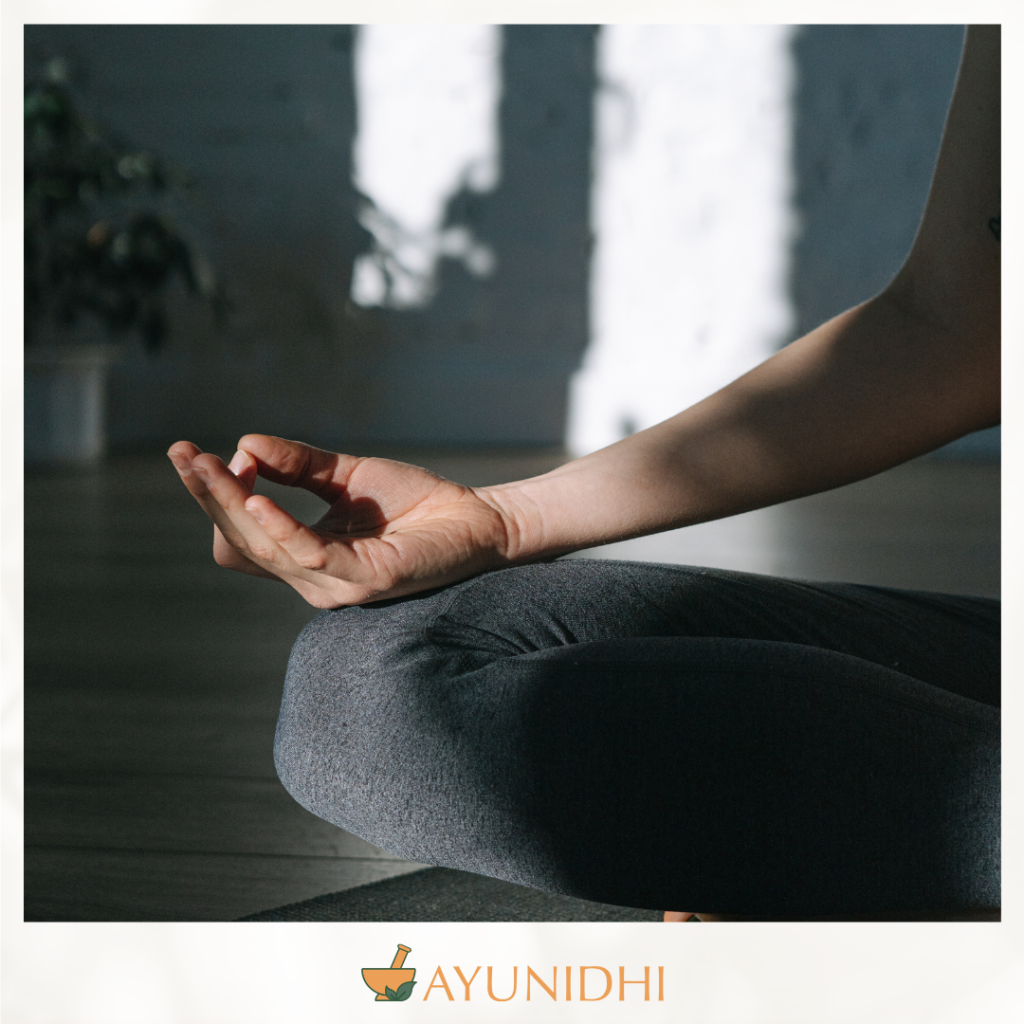
Nervous System Regulation with Yoga and Breath
Yoga and pranayama (breathwork) are some of the most effective, accessible tools to support Ayurveda for chronic stress.
A 2022 study in the Open Journal of Medical Psychology looked at adolescent students with high perceived stress who practiced a structured Hatha yoga program. After the intervention, they showed improvements in heart rate variability (a marker of healthy autonomic regulation) and significant reductions in perceived stress scores.
A recent narrative review on yoga and heart rate variability similarly concluded that yoga appears to modulate autonomic balance, enhancing parasympathetic (rest-and-digest) activity and reducing sympathetic overdrive, which is central to stress responses. One such review is summarized here (chapter on cardiovascular influence of yoga and HRV)
Ayurvedically, yoga and breath are prana medicine—when guided correctly, they calm vata, cool excess pitta, and gently mobilize stagnant kapha.
Practical nervous system supports you can use:
Grounding asana (poses)
• Child’s Pose (Balasana) to feel held and safe.
• Reclined Bound Angle (Supta Baddha Konasana) with support under knees to open the heart and pelvis gently.
• Legs-Up-the-Wall (Viparita Karani) to promote venous return, calm the mind, and shift the system out of stress mode.
Regulating pranayama
• Nadi Shodhana (alternate nostril breathing) to balance both sides of the nervous system; 5–10 slow rounds.
• Extended exhale breathing (inhale to 4, exhale to 6–8) to boost parasympathetic tone and signal “you are safe.”
• Bhramari (humming bee breath) to soothe internal noise and quiet ruminative thoughts.
You do not need an hour-long practice. Even 5–10 minutes, repeated daily, can gradually re-train your system away from chronic stress and freeze.
Herbal Allies for Chronic Stress and Shutdown
Herbs are not a replacement for therapy or medical care, but the right rasayanas (rejuvenatives) can support Ayurveda for chronic stress by calming the nervous system and rebuilding ojas.
Ashwagandha (Withania somnifera)
Ashwagandha is one of the best-studied Ayurvedic herbs for stress. In a randomized, double-blind, placebo-controlled trial published in the Indian Journal of Psychological Medicine, adults with chronic stress who took a high-concentration Ashwagandha root extract for 60 days had significantly lower perceived stress scores and lower morning cortisol compared to placebo.
Ashwagandha is a classic adaptogen: it helps the body adapt to stress, supports sleep, and nourishes depleted vata without being overly sedating. It’s especially useful in freeze states that began with long periods of fight-or-flight.
Tulsi (Holy Basil, Ocimum sanctum)
Tulsi is another gentle adaptogen widely used in Ayurveda to promote resilience and emotional clarity. Clinical trials have shown that tulsi extracts can reduce stress-related symptoms and improve sleep and quality of life. Many of these are summarized in a review of holy basil’s pharmacological properties, which highlights its antioxidant, anti-inflammatory, and stress-modulating actions:
Sipping tulsi tea through the day or using standardized extracts (with professional guidance) can support nervous system regulation, especially for women juggling multiple roles.
Other helpful herbs to discuss with a practitioner:
•Brahmi / Gotu Kola (Centella asiatica) for mental clarity and calm.
•Jatamansi (Nardostachys jatamansi) for deep relaxation and sleep support.
• Guduchi (Tinospora cordifolia) and Amalaki (Emblica officinalis) for immune support when stress has been long-term.
Always work with a qualified practitioner if you are pregnant, breastfeeding, on medication, or dealing with complex health conditions.
Daily Rhythms that Tell Your Body “You’re Safe”
A core principle of Ayurveda for chronic stress is that rhythm heals. The nervous system feels safer when it can predict the shape of your day.
Simple, realistic anchors:
Morning anchor
• Wake at roughly the same time.
• Drink warm water to gently stimulate digestion.
• Spend 3–5 minutes in breath and one or two grounding poses.
Food anchor
• Aim for regular meals, with lunch as your largest meal when digestion is strongest.
• Favor warm, cooked foods over cold and raw if you are depleted (soups, stews, kitchari, sautéed vegetables).
• Use gentle spices like cumin, coriander, fennel, ginger to support digestion without overheating pitta.
Evening anchor
• Dim screens and lights at least 30–60 minutes before bed.
• Try mini-abhyanga: massage your feet and scalp with warm sesame or almond oil for 2–5 minutes.
• Finish with a restorative pose and slow breathing; aim to sleep around 10 p.m.
Abhyanga (self-massage) in particular is deeply regulating for vata and chronic stress. Oil on the skin “coats” the nervous system, so to speak, and many women report feeling more grounded and less reactive with this one practice alone.
Food and Lifestyle for Rebuilding Ojas
To emerge from chronic stress shutdown, you are not just trying to calm the system; you are rebuilding your deep reserves.
Ojas-building supports include:
• Warm, nourishing, sattvic foods: kitchari, stewed apples or pears, root vegetables with ghee, lightly spiced milk (if tolerated), soaked almonds, dates.
• Reducing stimulants: caffeine, excessive sugar, and constant news or social media, all of which keep you in micro fight-or-flight.
• Gentle, consistent movement: walking, restorative yoga, non-competitive practices rather than intense, depleting workouts if you’re already exhausted.
• Healthy boundaries: saying “no” where your system is already overwhelmed; Ayurveda recognizes emotional load as a form of agni strain.
Remember: in freeze mode, your body needs to experience safety and nourishment, not more pressure, perfectionism, or extreme detoxes.
Trauma, Therapy, and When Ayurveda Needs to Be Part of a Bigger Team
Chronic stress and freeze responses often sit on top of trauma—relational, developmental, medical, or otherwise. Ayurveda for chronic stress can provide powerful tools, but it is not a substitute for trauma-informed therapy, psychiatric care when needed, or social support.
Signs you may need additional help:
• Persistent suicidal thoughts or self-harm urges
• Severe depression or anxiety that interferes with basic functioning
• Panic attacks, flashbacks, or dissociation
• Substance misuse to cope
• Eating disorders or self-starvation framed as “wellness”
In these cases, Ayurvedic supports (routine, food, herbs, yoga, breath) can be an adjunct to professional care, not the only intervention. Your healing deserves a team.
A Gentle Path Out of Shutdown
Chronic stress shutdown is not a personal failure; it is your body’s intelligent attempt to protect you when life has felt too much for too long. Freeze mode is a survival strategy that simply has stayed on beyond its useful time.
Ayurveda for chronic stress offers a compassionate reframe: you are not broken. Your agni, prana, and ojas have been overtaxed, and your doshas have shifted in response. With consistent, doable practices—warm meals, daily rhythm, soothing touch, breath, yoga, herbal support—you can teach your system that it is safe to come back online.
Modern research confirms what Ayurveda has said for centuries: chronic stress shapes inflammation and immunity in deep ways, while practices like yoga, breathwork, and adaptogenic herbs support nervous system regulation and resilience.
You do not have to fix everything at once. Start with one or two gentle changes: a daily breathing ritual, a warmer lunch, an earlier bedtime, a cup of tulsi or Ashwagandha (with guidance). Let those be your first signals of safety.
If you are ready to move out of chronic stress shutdown and into a more rooted, calm, and energized version of yourself, you do not have to do it alone. At AyuNidhi, I offer personalized Ayurvedic consultations and AyurYoga-based nervous system support designed specifically for women living in chronic stress patterns. Together, we can map where you are, understand your unique doshic picture, and create a plan that honors your real life while restoring your vitality.
You can take the next step by booking a first-time Ayurveda session or AyurYoga consultation and beginning your own guided, evidence-informed path back to balance.